
"Ugly Duckling": Navigating the Critical Four-Week Growth Spurt
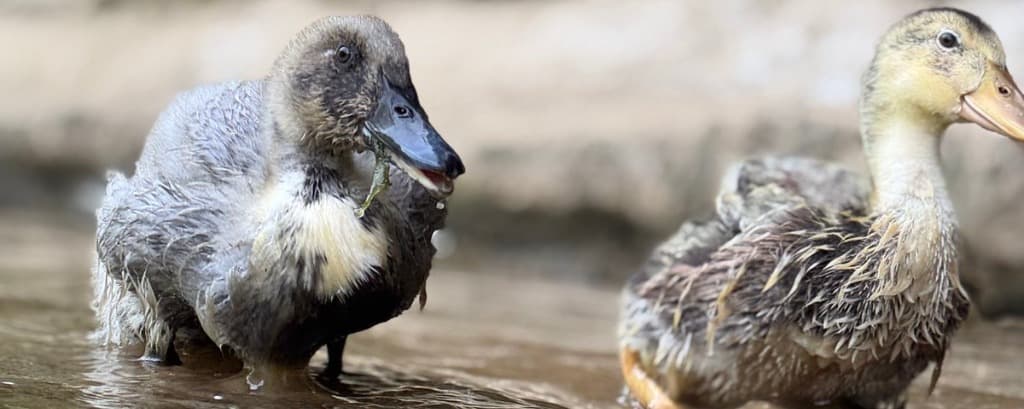
There is a reason the “Ugly Duckling” trope exists. Around the four-week mark, a duckling undergoes a biological transformation so rapid and chaotic that they often look like a completely different animal. This is the adolescent bridge — a period of patchy fuzz, oversized feet, and extremely high nutritional demand.
Understanding these changes is the difference between a duck that struggles with mobility and one that thrives for years.
The Biological “Ugly” Phase
Between weeks three and six, a duckling’s body prioritizes skeletal frame and internal organs over pretty plumage.
- Feather Transition: Soft yellow down is pushed out by blood feathers — thick, sensitive quills full of blood vessels. This is why they look so patchy.
- Voice Change: The syrinx expands. The high-pitched peep begins to crack. Females start finding their loud quack; males develop a deeper, raspy sound.
The Niacin Crisis
A duckling’s weight can increase by several hundred percent in the first month. This puts enormous strain on still-soft leg bones.
If the bird does not get enough niacin (Vitamin B3), the bones cannot calcify fast enough to support the growing body. The result is bowed or splayed legs. Ducks have a higher niacin requirement than chickens, which is why this problem is so common when people use standard chick starter.
Peas as a practical tool
Peas are highly useful during this stage:
- Their niacin is readily available
- They supply clean plant-based protein for feather growth
- Serving them in water encourages natural dabbling and coordination
Hydro-Therapy: Why Swimming Matters
Swimming at this age is more than enrichment — it is physical therapy.
-
Zero-gravity muscle building
On land the legs carry constant weight. In water that load disappears, allowing the bird to strengthen thigh and hip muscles safely. -
Full range of motion
Paddling develops proper joint movement and helps prevent the stiff gait or tendon issues that can appear when birds are raised only on hard, flat surfaces. -
Sinus and eye hygiene
Ducks need to fully submerge their heads to flush their nares and keep their eyes clean. As they begin foraging more in mud, this becomes especially important.
Reclaiming the “Ugly Duckling”
When a duck looks its most awkward — patchy, uncoordinated, and strange — it is actually doing its hardest developmental work. It is building the foundation for the strong, waterproof adult it will become just a couple of weeks later.
By focusing on niacin-rich nutrition and consistent access to water deep enough for head-dipping, you are not just watching them grow. You are actively supporting the structural health of the adult bird.
The “ugly” phase is one of the most important — and most beautiful — parts of the process.