
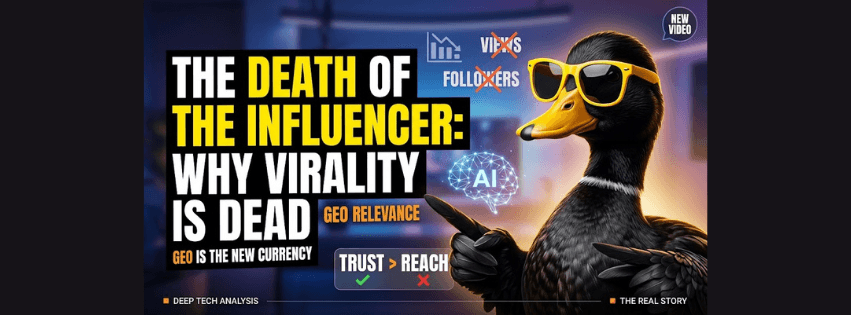
The Death of the Influencer: Why Virality Is Dead and GEO Is the New Currency
Why the traditional era of social media influencing is over, how synthetic AI media commoditizes view count, and why topical authority and Generative Engine Optimization (GEO) are the new currency.
There is an iconic scene in Eminem’s “The Real Slim Shady” music video where he poses a simple question: “Will the real Slim Shady please stand up?” Immediately, an entire room of identical, bleached-blonde clones stands in unison.
Welcome to the current state of social media.
Everyone with a smartphone, a ring light, and an affiliate dashboard has spent the last five years trying to become an influencer. But just as the room reached peak saturation, the floor dropped out.
The traditional era of social media influencing is over. Not because people stopped scrolling, but because the foundational pillars of the industry—organic trust, follower vanity metrics, and human production advantages—have completely collapsed under the weight of commercial saturation, algorithmic shifts, and generative AI.
If you are a creator trying to navigate what comes next, chasing virality on a hamster wheel is no longer a career path. It’s a race to the bottom.
1. The Death of the Organic Recommendation
Remember when someone shared a product simply because it solved a problem?
Today, audiences operate with default cynicism. We assume every enthusiastic product review, every morning routine, and every "holy grail" find is tethered to a commission link, a sponsored brief, or a PR shipment.
While pay-per-post deals still exist, the massive shift toward affiliate commissions incentivized creators to turn every single upload into a high-octane sales pitch. The result? Over-hyped, mediocre products masquerading as authentic peer discoveries.
Audiences didn't just get tired of ads—they developed an immunity to them. When every opinion is bought and paid for, no opinion holds value.
2. The Virality Mirage: Reach ≠ Leverage
The vanity metric of the past decade was the follower count. The vanity metric of today is the viral hit.
Both are illusions.
The modern discovery algorithm proved that you don’t need an audience to get reach. You can post a 20-second video with the text "You don’t have to be famous to go viral," stare into space at a fire extinguisher, and pull millions of impressions. The algorithm needs endless content to keep users glued to the glass, and it will distribute anything that holds attention for eight seconds.
flowchart TD
    subgraph Old Social Contract
    A1["Build Audience"] --> A2["Earn Trust"] --> A3["Distribute Value"]
    end
    subgraph Current Reality
    B1["Chase Algorithm"] --> B2["Get Reach"] --> B3["Zero Retention"]
    end
    subgraph The New Model
    C1["Build GEO/Depth"] --> C2["Earn Trust"] --> C3["True Direct Influence"]
    end
When reach is commoditized, virality loses its commercial power. A million views from people who don’t know who you are, what you stand for, or why they should care yields zero lasting leverage.
500 people who genuinely trust your perspective will generate more sustainable growth and real-world impact than 50,000 drive-by followers who paused on your video for three seconds.
3. The Synthetic Shift: When AI Outproduces the Individual
For years, creators relied on sheer human output—filming, editing, testing formats—to beat the algorithm. That moat is officially gone.
Generative AI video, voice cloning, and synthetic personas have reached a point where the average consumer cannot reliably distinguish real human output from prompt-engineered media.
- AI doesn’t burn out.
- AI doesn’t demand a higher commission rate.
- AI can test 500 visual hooks, scripts, and editing rhythms in the time it takes an independent creator to set up a tripod.
Trying to out-produce synthetic media on traditional video platforms is a losing battle. When AI can generate infinite, photorealistic content tailored to whatever trend is peaking that afternoon, human content creation for the sake of volume is obsolete.
4. The GEO Shift: From Chasing Algorithms to Optimizing for Relevance
Search and discovery behavior is fundamentally changing. People are moving away from scrolling through twenty sponsored video ads or navigating ten blue Google links littered with SEO affiliate spam. Instead, they are turning directly to AI engines to do their research:
- "What is the most durable setup for X?"
- "Who is actually doing credible work in Y?"
- "What is the real consensus on Z without the paid influencer fluff?"
AI models do not care about a dance trend or a 3-second hook designed to manipulate watch time. They synthesize information based on topical authority, consistency, documented real-world experience, and depth.
| | The Influencer Era | The Authority Era | | :--- | :--- | :--- | | Goal | Virality & Broad Reach | Niche Relevance & Depth | | Metric | Views & Follower Counts | Trust & Conversion | | Channel | Algorithmic Feeds (FYP) | Direct Audiences & GEO | | Asset | Surface Persona | Proprietary Knowledge/Work |
The future isn't about gaming an algorithm to get on a random teenager's feed. It’s about becoming the definitive, trusted entity in your domain so that when both humans and AI search engines look for answers, your perspective is the primary source.
The Next Move for Creators
The death of traditional influencing is not the death of independent media—it’s a correction. It is stripping away the shallow middle layer of creators who built businesses purely on manufactured lifestyle aesthetics and paid hype.
To build something that lasts in this new landscape:
- Trade Reach for Depth: Stop tailoring every piece of content for broad appeal. Build hyper-specific authority in a lane where AI cannot replicate your lived experience.
- Prioritize Trust Over Sponsorships: Guard your reputation ruthlessly. The moment your audience realizes you recommend things for margin rather than merit, you lose the only asset AI can't generate.
- Optimize for Search & Intent (GEO): Think about how an AI engine indexes your knowledge. Structure your insights, case studies, and perspectives so they serve as foundational source material across the web.
- Own the Connection: Move people off volatile discovery feeds into direct platforms—communities, newsletters, direct networks—where an algorithm update or synthetic wave can’t erase your audience overnight.
The era of the "Slim Shady" influencer army is ending. The creators who thrive next won't be the loudest or the most viral—they will simply be the ones worth trusting.