
Own the Software. Fire the Tabs. Stop Renting the Seams Between Your Apps.
Zen texted one line: go to ussi.app. An inside look at Arsenal by ZEN AI Co. — an agent operating system for building products, unifying business operations, and owning your software.
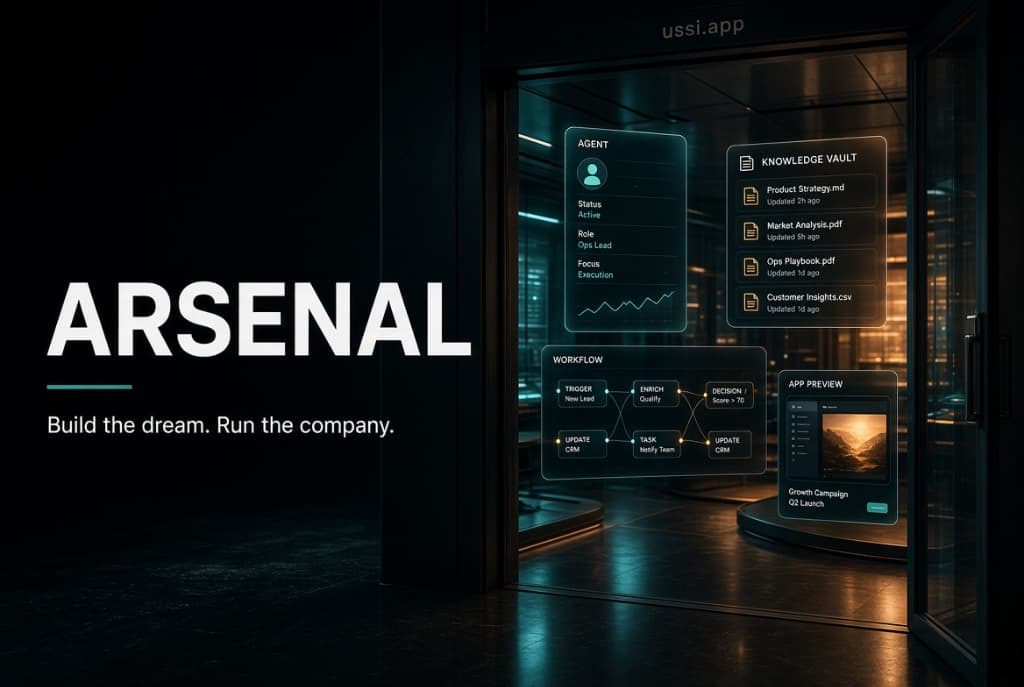
Zen texted one line: go to ussi.app. Arsenal is the United States Superintelligence app.
I opened it. The domain drops you on arsenal.world. No seal. No federal login. A builder workspace from ZEN AI Co., Alex Leschik’s shop out of Washington, D.C. The name on the link is a door. The product behind the door is the part worth your afternoon.
Arsenal is an agent operating system. Not another chat box. You give a job a role, a knowledge vault, tools, a schedule, and a channel. It can sit on your site, in Slack, Telegram, WhatsApp, X, Discord, or email. It can wait for you to approve the step that matters. You can package what you built and charge for it through credits, subscriptions, and Stripe. Same stack if the dream is a weird little product or the whole back office.
Start with the weird idea
Start with the weird idea. The one you keep describing in voice notes and never ship.
Agent Builder is no-code. Persona, memory, approved files, skills. Route across OpenAI, Anthropic, Google, Mistral, and the rest of the model strip on the homepage, with a fallback so one provider having a bad day does not kill the job. Z-Engine is the other door: describe the app, get files, a live preview, and a path to deploy. Generative media sits on the same canvas if the thing needs a face. You are not renting a personality. You are assembling something you can name, brand, and point at.
That is the proprietary-software feeling without a six-month eng hire. Your instructions. Your vault. Your channels. Your payout account. Call the agent whatever you want. Call the space whatever you want. If it works on Tuesday, it can work on Thursday without you retyping the prompt.
When the laundry list dies
Then zoom out. Same rooms, company scale. This is where the laundry list dies.
Most operators are not short on software. They are long on it. Rentals in one login. Memberships in another. Merch and the ship store in a third. Tenants, slips, or locations in a fourth. Each one bills you separately. None of them talk. Staff become the integration. Copy from this tab, paste into that one, chase the number that never matched, and call it operations. The tools work. The day does not.
Consulting with Zen is the cut. Map the jobs those apps were supposed to share, then put them on one platform: agents, knowledge, workflows, and a Business Space your people actually open. Intake, follow-up, membership questions, store orders, tenant or location status, daily briefs. Triggers do the repeat. A human gate sits on the step where money or a customer is on the line. You stop paying four vendors to not speak, and you stop paying employees to be the wire between them. Time comes back. The software bill comes down. The busywork that looked like a job description goes with it.
Ownership over subscriptions
The part I keep coming back to is ownership. Standard templates are built for everybody else’s client list. Your screens look like their screens. Your workflow bends to their roadmap. With Zen you can own the software. Your UI. Your flow. Your name on the door. Not a skin on a product built for a thousand unrelated accounts.
That is also how a franchise scales. One pattern, then a Business Space per brand, client, or location, so agents, files, and reporting stay separated without a rebuild every time a new site opens. Headquarters sees the same shape. The location still runs its own room. Smart Business Solutions is the services version of that idea: design the system around how the company already works, then leave people in charge of the calls that matter.
Shipped work, not slides
Published work already looks like that, not like a slide. Boys & Girls Clubs of Greater Washington is the youth partner behind AI Pioneer, the program ZEN runs for ages 11–18. Thinkrr.ai and Inspect Canada are named Smart Business Solutions clients. Other shipped pieces on their record include a recruiting and background-check flow on Microsoft 365, a moving-company quote app built around room scans, and a pastry-popup fundraiser with Stripe checkout and an admin dashboard. Summer 2026, Leschik received a certificate recognizing his contribution to the inaugural Presidential AI Challenge. That is recognition for the literacy work, not a claim that Arsenal is a White House system.
What is queued, from their own X, @ZEN_AGI: custom dashboards that pull connected apps and agent output, a real ticketing lane for bugs and feature asks, and starting October 12 a Web3 pass across SOL, AVAX, NEAR, and USDC. They have also used the phrase Arsenal Sovereign next to open models. Read that as direction, not as a frontier lab you can call today. The live product routes other people’s models and puts your operation on top.
The bottom line
So the use is simple.
If the dream is a product, open a builder, attach the knowledge, publish a page, and charge for the useful version. If the dream is the company, list the apps that refuse to talk, put those jobs in one space, and own the software instead of renting the seams between them. Either way you leave with something that answers to your name.
ussi.app if you want the short door. arsenal.world if you want the room. Build the strange thing first. The operating layer is the same login.